Face stamping uses a handheld device fitted with tiny needles to press into the skin. At-home use can cause irritation, infection, scarring or changes in pigmentation, particularly when the skin is punctured or excessive pressure is used. This guide explains those risks, how DIY stamping differs from professional microneedling, and why a skin assessment matters before treatment.
What is the face stamping trend, exactly?
Face stamping is a do-it-yourself take on microneedling. Instead of a roller or a professional pen, users press a flat, palm-sized stamp studded with fine needles straight down into the skin, then lift and move to the next spot. Depending on the device, the needles range from very short (marketed for “product absorption”) to surprisingly long (marketed for scars and texture). The idea is that each press creates a grid of micro-injuries, and as the skin repairs those tiny wounds, it lays down fresh collagen and elastin.
The trend picked up a specific look in short-form videos filmed in China, Korea, and across the wider Asian beauty scene: someone methodically stamping across the cheeks and forehead, often layering on a serum or an “ampoule” afterward, then revealing plumped, glowing skin. The devices are cheap, often under twenty dollars, and they ship fast. That combination of low price, dramatic before-and-after clips, and the promise of a clinic-grade result at home is exactly why it spread.
Here is the important nuance. The concept behind stamping is not fake. Controlled micro-injury genuinely does trigger collagen remodeling. That is the same biological principle behind professional microneedling. The problem is not the idea. The problem is doing it yourself, with an unsterile tool, at a needle depth you cannot judge, on skin you cannot properly assess.
Why did face stamping go viral in the first place?
A few forces stacked up at once. Understanding them helps you see why the trend is sticky and why it is also risky.
First, the visual payoff is immediate and satisfying. Any micro-injury to the face causes a brief inflammatory flush and mild swelling, which temporarily blurs pores and fine lines. On camera, that reads as an instant “glow.” Viewers assume they are watching new collagen appear. They are actually watching short-term inflammation, which fades within a day or two.
Second, the tools are almost free compared to a clinic visit. When a stamp costs less than a lunch and a professional treatment costs a few hundred dollars, the DIY route feels like a clever hack rather than a shortcut with hidden costs.
Third, the “skinimalism” and DIY-longevity movements gave the trend a wellness halo. Doing your own regenerative treatment at home sounds empowering and modern. It fits a broader cultural moment where people want to take skin health into their own hands.
Fourth, algorithms reward transformation content. A stamping video with a dramatic reveal gets shared, which pushes it to more feeds, which invites more creators to try it. Very few of those videos show the person three weeks later, when a reaction, a breakout, or a lingering red mark might tell a different story.
What are the real risks estheticians and dermatologists warn about?
This is where balance matters. Face stamping is not guaranteed to harm you, and plenty of people try it once without obvious injury. But the risk profile is meaningfully higher than clinic microneedling, and the potential downsides are the kind you do not want on your face. Here are the ones skin professionals raise most often.
Skin barrier damage. Your barrier is the outermost layer that holds moisture in and keeps irritants and microbes out. Aggressive or too-frequent stamping, especially with longer needles, can breach that barrier faster than it can heal. The result is the opposite of what people want: tightness, stinging, flaking, redness that will not settle, and skin that suddenly reacts to products it used to tolerate. Once the barrier is compromised, recovery can take weeks of gentle care.
Infection. This is the risk professionals worry about most. Needles create open channels straight into living tissue. At home, most people cannot truly sterilize a device. An alcohol wipe reduces surface germs, but it does not match medical-grade sterilization, and reusing a stamp across sessions can drive bacteria deep into the skin. That can lead to painful breakouts, folliculitis, small abscesses, or, in rarer cases, more serious infection. Sharing a device or storing it in a humid bathroom makes this worse.
Broken capillaries and lasting redness. The face, especially around the nose and cheeks, is rich in tiny blood vessels sitting close to the surface. Blunt, uneven pressure from a stamp can rupture them, leaving thread-like red marks that do not fade on their own and often need laser treatment to correct.
Uneven, angled wounds and scarring. Professional devices drive needles straight in and straight out to create clean vertical channels. A handheld stamp pressed at a slight angle, or dragged even slightly, can tear rather than puncture. Uncontrolled trauma like this is what raises the odds of increased texture, pitting, or scarring, particularly for anyone prone to keloids.
Post-inflammatory pigmentation. For medium and deeper skin tones, any uncontrolled inflammation carries a real risk of dark marks that linger long after the “treatment.” This is one reason a proper skin assessment matters before any needling.
Wrong tool for the actual concern. Active acne, rosacea, eczema, a cold sore, or a mole in the treatment zone can all be made worse by stamping. A professional screens for these. A viral video does not.
Does any evidence support DIY face stamping?
The honest answer is that the evidence supports the mechanism, not the method. Clinical research on professional microneedling shows it can improve acne scarring, fine lines, and overall texture when performed correctly at appropriate depths and intervals. That body of work is real, and it is why regenerative clinics use these tools.
What is missing is good evidence that unsupervised, at-home stamping delivers those same benefits safely. Home devices are usually shorter, less consistent, and used without the depth control, sterility, or spacing between sessions that the clinical studies relied on. In other words, the studies people cite to justify the trend were done under conditions the trend does not replicate. Most of what you see online is anecdote and short-term inflammation, not measured, lasting improvement. When the mechanism is sound but the execution is unregulated, the safe conclusion is to keep the mechanism and fix the execution.
Face stamping (DIY) versus professional treatment: how do they compare?
The table below lays out the practical differences. This is the clearest way to see why the same underlying idea produces very different outcomes depending on who holds the needle.
| Factor | DIY face stamping | Professional microneedling / microchanneling |
|---|---|---|
| Sterility | Home cleaning or an alcohol wipe; device reused | Single-use sterile cartridges, medical-grade protocols |
| Needle depth | Guessed, inconsistent, hard to control | Set precisely to the concern and the treatment zone |
| Skin assessment | None; you screen yourself | Trained assessment of skin type, conditions, and contraindications |
| Wound quality | Risk of angled, tearing wounds | Clean vertical channels for even remodeling |
| Serums applied | Non-sterile products pushed into open skin | Regenerative actives suited to needling (for example exosomes) |
| Infection risk | Higher, and largely on you to manage | Controlled clinical environment |
| Evidence base | Weak for the at-home method | Supported for the supervised, correctly performed treatment |
| If something goes wrong | You are on your own | A professional guides recovery and follow-up |
| Real cost | Cheap upfront, expensive if you have to fix damage | Priced as a service, with the safeguards built in |
The pattern is consistent. The clinic version is not just a fancier tool. It is an entirely different level of control over depth, sterility, and the products that go into the freshly opened skin.
How is professional microchanneling different from a stamp at home?
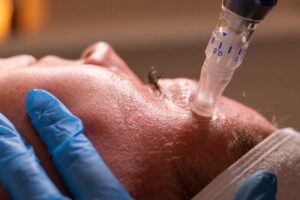
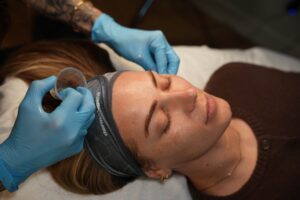
Microchanneling is often described as an advanced, more consistent form of microneedling, and it is closer to what the stamping trend is imitating than most people realize. A professional device creates uniform micro-channels at a set depth, with even pressure, while the practitioner works to a plan built around your skin. Because the channels are clean and consistent, the collagen response is more predictable and the recovery is smoother.
The other major difference is what gets delivered into those channels. In a clinical setting, the freshly created micro-channels can be paired with regenerative actives chosen for the moment, such as exosomes that support the skin’s repair signaling, or peptide and polynucleotide serums selected for your goals. That is a controlled delivery of sterile, purpose-made ingredients. Compare that to pressing whatever serum is on your shelf into open wounds at home, where the product was never formulated to be introduced below the skin surface and may contain fragrances or preservatives that irritate raw tissue.
If you want to understand the science of how needling and targeted actives work together, our explainer on microneedling with peptides walks through the mechanism in plain language. It is a good primer before any needling decision.
What does a safe, professional alternative look like at Grace Hill?
The good news is that everything the face stamping trend promises, smoother texture, refined pores, a genuine glow, is available through treatments designed to deliver it with medical-grade products and highly qualified and certified aestheticians. At Grace Hill in Winnipeg, our regenerative approach starts with an assessment, then matches the method to your skin rather than to a viral clip.
For the collagen-building goal that stamping chases, professional microneedling with exosomes creates controlled micro-channels and pairs them with regenerative signaling, all in a sterile setting. It is the properly done version of the thing people are trying to copy at home. For texture, tone, and radiance, professional resurfacing options such as our corrective and clinical peels, Retinol-Tech Glow, and LuminFusion can refine the surface without needles at all. And for those who see skin as part of a longer game, our longevity-focused treatments look at repair and resilience over time rather than a one-day flush.
This philosophy, treating skin as a system to support rather than a surface to shock, is exactly what we cover in our post on regenerative aesthetics versus traditional anti-aging. It is the difference between chasing a quick reaction and building lasting skin health.
How can you spot a risky viral skincare tool before you try it?
Trends will keep coming, so a simple filter is more useful than a warning about any single one. Before you buy the next viral device, ask a few questions. Does it break, puncture, or burn the skin barrier in any way? If yes, that is a treatment, and treatments belong with a trained professional. Can the tool truly be sterilized between uses, and are you equipped to do that? Is the “before and after” showing lasting change, or just the swelling and flush that any irritation produces? Does the trend account for your specific skin type, conditions, and tone, or does it assume everyone reacts the same way?
If a tool fails those questions, it does not mean the underlying science is worthless. It usually means the science is real and the delivery is the problem. That is the moment to book a consultation rather than a marketplace order. You keep the benefit and get quality, medical-grade guidance.
Frequently Asked Questions
Is face stamping the same as professional microneedling?
No. They share a mechanism, controlled micro-injury to trigger collagen, but not the execution. Professional microneedling uses sterile single-use cartridges, precise depth control, a trained skin assessment, and regenerative serums made for needling. DIY face stamping relies on a reused tool, guessed depth, and no screening, which is where most of the damage risk comes from.
Can face stamping permanently damage your skin?
It can. The most common lasting problems are broken capillaries that need laser correction, post-inflammatory pigmentation, and scarring from angled or tearing wounds. Barrier damage is usually reversible with weeks of gentle care, but infection and scarring can leave permanent marks. Risk rises with longer needles, frequent use, and poor sterilization.
Why do people look glowing right after face stamping?
That immediate glow is mostly short-term inflammation. Micro-injury causes a brief flush and mild swelling that temporarily plumps the skin and blurs pores and fine lines. It usually fades within a day or two. It is not the same as new collagen, which forms gradually over weeks and only when the treatment is done correctly.
Is at-home microneedling ever safe in Winnipeg?
The safest choice is to have any skin-puncturing treatment performed professionally. Clinics sterilize tools, control depth, screen your skin, and guide recovery. If you are curious about needling for scars, texture, or glow, a consultation at a Winnipeg clinic like Grace Hill will tell you whether you are a good candidate and which method fits your skin.
What should I do if my skin reacts badly after stamping?
Stop immediately and simplify your routine to a gentle cleanser and a bland moisturizer to support barrier repair. Avoid actives like acids and retinoids until the skin calms. If you see spreading redness, pus, increasing pain, or marks that will not fade, seek professional care promptly, because these can signal infection or capillary damage that needs treatment.
What professional treatment gives the results face stamping promises?
Professional microneedling with exosomes is the closest safe equivalent, since it creates controlled micro-channels and delivers regenerative actives in a sterile setting. For glow and texture without needles, corrective peels and resurfacing treatments work well. The right option depends on your skin, which is why an assessment comes first.
Skip the Risky Viral Tools: Book a Regenerative Consultation at Grace Hill
You do not have to gamble with a discount stamp to get smoother, brighter, healthier skin. Everything the face stamping trend promises, refined texture, a real glow, a genuine collagen boost, we deliver safely and professionally right here in Winnipeg. Explore our regenerative options, including microneedling with exosomes and our resurfacing menu, on the Grace Hill Med Spa page, or take a longer view of skin health on our longevity menu. When you are ready, book a consultation and let us build a plan around your skin, not a viral clip. Skip the risky tools. Choose the version that is done right.
This article is for general education and is not medical advice. Book a consultation for guidance specific to you.
GRACEHILL SALON & SPA · WINNIPEG
Book Skincare Treatments in Winnipeg
Explore our service menu and book an appointment online. Not sure what service to choose? Fill out a consultation form and one of our experts will reach out to discuss a customized treatment plan.