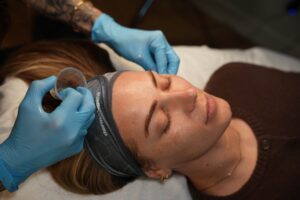
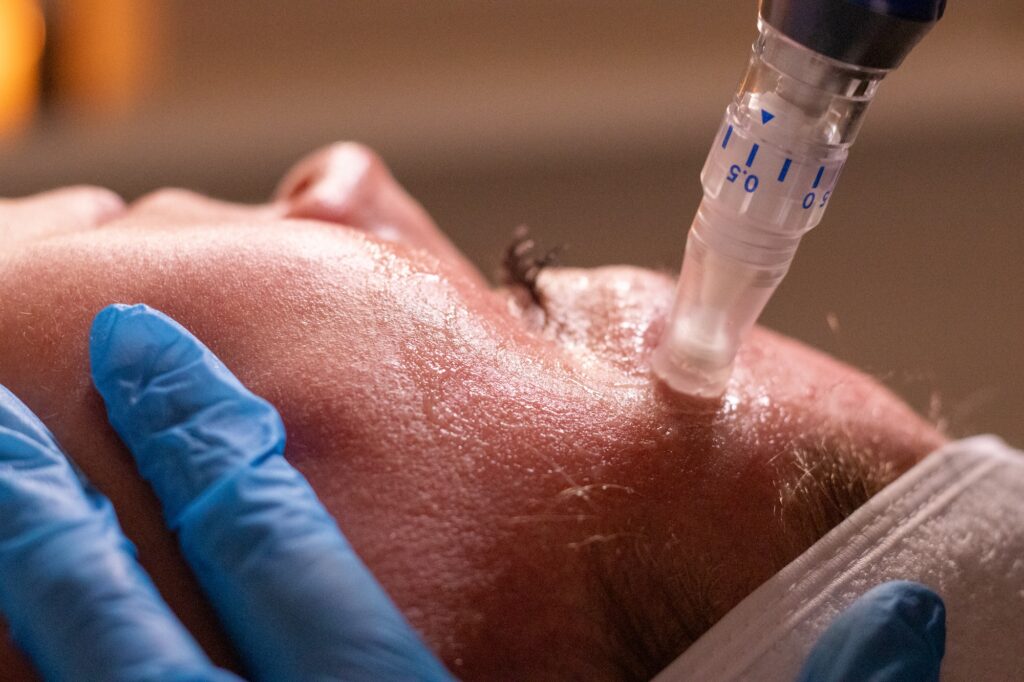
Exosomes for skin are tiny cell-signaling messengers, applied topically after microneedling, that aim to prompt your skin’s own repair and collagen-building response for smoother texture, more even tone, and faster recovery. The science is genuinely promising and moving fast, though it is still early, so the honest framing is “encouraging and worth understanding,” not “miracle in a vial.”
If you are researching exosomes for skin in Winnipeg, this guide explains what exosomes actually are, why they are so often paired with microneedling, what the current evidence does and does not show, and how regulation and sourcing fit in. At Grace Hill Salon & Spa in Corydon Village, microneedling with exosomes is one of the regenerative treatments we offer, and we would rather you arrive at a consultation genuinely informed than dazzled by hype.
What are exosomes, and why is everyone talking about them?
Exosomes are nanoscale vesicles, essentially microscopic bubbles, that cells release to communicate with one another. Think of them as tiny couriers. Inside each one is a parcel of biological cargo: proteins, lipids, growth factors, and genetic signaling molecules such as messenger RNA and microRNA. When one cell wants to influence the behaviour of another, it can package instructions into an exosome and send it along.
In skin science, the interesting part is that cargo. The exosomes used in aesthetic products are typically derived from cultured stem cells, often mesenchymal stem cells, and they carry the kinds of signals associated with tissue repair, collagen production, and calming inflammation. The idea is not to add new cells to your skin. It is to deliver the messages that encourage your existing skin cells (particularly fibroblasts, the cells that make collagen and elastin) to behave in a more youthful, regenerative way.
That is a genuinely different concept from most of what has come before. Traditional anti-aging tends to correct what is already visible. Regenerative approaches, which we explore in our overview of regenerative aesthetics versus traditional anti-aging, aim to support the skin’s own biology so it functions and repairs better over time. Exosomes sit right at the frontier of that conversation, which is exactly why they generate so much excitement, and why they deserve a careful, evidence-based read.
How are exosomes used in skin treatments?
In a reputable clinic, exosomes for skin are used topically, and almost always alongside a procedure that temporarily opens the skin’s surface so the exosome serum can reach beyond the outermost barrier. Microneedling is the natural partner, which is why exosome microneedling has become the flagship way these products are delivered.
Here is the logic. A microneedling device passes very fine needles across the skin, creating thousands of controlled micro-channels. Those channels do two useful things at once. First, the micro-injury itself signals your skin to launch its repair cascade, the same collagen-induction process that makes microneedling effective on its own. Second, for a short window afterward, those channels create temporary pathways that can help suitable topicals penetrate more deeply than they otherwise could. The exosome serum is applied into and after that window, so the signaling cargo has a better chance of reaching the living layers of the skin where fibroblasts are working.
We cover the delivery science in more depth in our companion article on the science behind microneedling with peptides, and the same principle of transient, enhanced absorption applies here. The important nuance is that the microchannels close over a number of hours, so this is about a short-lived delivery advantage, not a permanent change to your skin barrier.
You may also see exosomes offered as an add-on to other resurfacing or energy-based treatments, or applied as a soothing, recovery-supportive layer afterward. What responsible providers do not do is inject them. That distinction matters, and we will come back to it under safety and sourcing.
What are the claimed benefits, and what does the evidence actually say?
Early research is promising, but results are specific to the products studied. A 12-week study involving 28 participants found greater improvements in wrinkles, elasticity, hydration and pigmentation with one exosome-containing solution plus microneedling than with saline plus microneedling. This small study does not establish that every exosome serum—or Grace Hill’s particular treatment—will deliver the same results.
Read more about the early research here.
Exosomes vs PRP vs growth factors: how do they compare?
Exosomes are not the only regenerative option that works alongside microneedling. Two others come up constantly: PRP (platelet-rich plasma) and isolated growth factor serums. They overlap in spirit but differ in source, evidence, and practicality. Here is an honest side-by-side to frame a consultation.
| Feature | Exosomes | PRP (platelet-rich plasma) | Growth factor serums |
|---|---|---|---|
| What it is | Stem-cell-derived signaling vesicles carrying proteins, lipids, and genetic messengers | Concentrated platelets from your own blood, drawn and spun on the day | Isolated or lab-made growth factor proteins in a topical formula |
| Source | Manufactured product (donor or cultured cells) | Autologous, meaning it comes from you | Manufactured product, plant, human, or synthetic origin |
| Typical use with microneedling | Applied topically into the microchannels | Applied topically or injected by a qualified provider | Applied topically into the microchannels |
| Evidence maturity | Early and promising, mostly small studies | More established, though results still vary | Mixed, varies a lot by formulation |
| Main appeal | Rich, targeted signaling cargo | Uses your own biology, no foreign product | Convenience and consistency |
| Key limitation | Regulatory status and sourcing vary; not for injection | Requires a blood draw; results depend on your blood | Actual active content and potency differ by product |
| Cost | Premium add-on | Moderate to premium | Usually the most accessible |
Read this as a map, not a verdict. PRP has the advantage of coming from your own body. Exosomes offer a concentrated, standardized signaling payload. Growth factor serums are the most accessible entry point. None is universally “best,” and the right choice depends on your skin, your goals, and an in-person assessment.
Are exosome treatments safe, and does sourcing matter?
Safety with exosomes comes down to two things: how they are used, and where they come from. Both are worth understanding before you book anywhere.
On the how, the safest and most defensible use of exosomes right now is topical, applied to the skin after microneedling, not injected. This is not a small technicality. Neither Health Canada nor the United States FDA has approved any exosome product for injection, intravenous use, or implantation. In fact, in August 2025 Health Canada opened a formal consultation on how topical products containing human-derived exosomes should be classified, signalling that the regulatory framework is still being written. A clinic that offers exosomes as a topical layer after microneedling is working within the current, cautious standard. A clinic injecting them is not, and that is a meaningful red flag.
On the where, sourcing and quality control genuinely matter because exosomes are a manufactured biological product. Composition, concentration, purity, and handling can vary between suppliers, and the regenerative field has attracted its share of overstated marketing. The right questions to ask are simple: What product is being used? Where is it sourced and manufactured? How is it handled and stored? A provider who can answer clearly, and who frames exosomes honestly as an early-stage, supportive therapy, is one worth trusting.
The procedure exosomes accompany, microneedling, is itself well established and generally well tolerated when performed professionally, with typical short-term effects like redness, mild swelling, and sensitivity for a day or a few. As with any treatment, suitability varies. Active skin infections, certain skin conditions, pregnancy, and some medical histories can make microneedling inappropriate, which is why a real consultation always comes first.
How does Grace Hill offer microneedling with exosomes?
At Grace Hill, exosomes are part of a broader regenerative, longevity-minded philosophy rather than a standalone gimmick. We offer microneedling with exosomes as a professional, in-clinic treatment: controlled microneedling to trigger your skin’s repair response and open that transient delivery window, followed by a suitable exosome serum applied topically to support signaling, calm, and recovery.
Everything is built around a consultation first. Before any needling happens, we assess your skin, talk through your history and goals, and confirm the approach genuinely suits you. We are candid about what exosomes can and cannot do, we do not inject them, and we set expectations around a series of sessions rather than a single dramatic before-and-after, because collagen remodeling is a gradual, cumulative process.
Because exosome microneedling fits so naturally within a regenerative approach, it often sits alongside other treatments in our longevity menu and the wider range in our Targeted Resurfacing & Peels and Pro Clinical Facials menus. Whether exosomes are the right next step, or whether classic microneedling, a peel, or another option suits you better, is exactly the kind of thing a consultation is designed to sort out.
What can you expect, and who is a good candidate?
If you and your provider decide exosome microneedling is appropriate, a session generally follows a familiar rhythm: cleanse, numbing as needed, the microneedling pass at a depth chosen for your skin, then application of the exosome serum, and finally soothing, barrier-supportive aftercare with sun protection guidance. Most people experience redness resembling a mild sunburn for a day or a few, sometimes with light swelling or flaking as the skin settles. Makeup and sun exposure are usually limited briefly while your barrier recovers.
Results build gradually. Skin often looks refreshed within a week or two, but the deeper collagen remodeling continues over the following months, which is why a planned series usually outperforms a single visit. Good candidates tend to be people looking to support overall skin quality, texture, tone, early signs of aging, or recovery, who understand this is a supportive, progressive treatment rather than a guaranteed fix. It is less suitable for anyone expecting dramatic tightening of significant laxity, which is a structural concern better addressed by other means. A consultation is the honest way to find out where you fit.
What do exosome skin treatments cost in Winnipeg?
Pricing depends on the clinic, the specific exosome product used, and how many sessions you plan, so treat any figure as a general guide rather than a quote. Microneedling on its own commonly runs in the range of roughly $300 to $900 per session in Canada. Exosomes are a premium add-on, typically adding somewhere in the range of about $200 to $500 per session depending on the product and concentration. A full course, usually a series of three, therefore often lands somewhere in the region of $1,200 to $3,000 in total.
Because these ranges move with product and provider, the only way to get an accurate number for your skin and goals is a consultation. At Grace Hill we would rather quote you honestly in person than have you budget from a generic figure online. You can see our current treatment offerings and book through our services page.
Frequently Asked Questions
What are exosomes in skincare?
Exosomes are nanoscale vesicles that cells use to communicate, carrying proteins, lipids, and genetic signaling molecules. In skincare, the exosomes used are usually derived from cultured stem cells, and the goal is to deliver repair-related signals that encourage your own skin cells to build collagen and calm inflammation, rather than adding new cells.
Do exosome treatments for skin actually work?
Early evidence is promising but limited. Systematic reviews of exosome microneedling report encouraging results for texture, tone, photoaging, and scarring, with some studies showing more improvement than microneedling alone. However, most studies are small with short follow-up, so exosomes are best seen as a supportive therapy, not a guaranteed transformation.
Are exosomes safe, and are they approved in Canada?
Used topically after microneedling, exosome treatments are generally well tolerated when performed professionally. Importantly, no exosome product is approved by Health Canada or the FDA for injection. Health Canada opened a consultation on classifying topical exosome products in 2025, so the framework is still developing. Reputable clinics use them topically, never injected.
What is the difference between exosomes and PRP?
PRP (platelet-rich plasma) is concentrated from your own blood on the day of treatment, so it is autologous and uses your own biology. Exosomes are a manufactured product derived from cultured cells, offering a standardized signaling payload. PRP has a longer track record, while exosome evidence is newer and still emerging. A consultation helps decide which suits you.
How many exosome microneedling sessions will I need?
Most plans involve a series, commonly around three sessions spaced several weeks apart, because collagen remodeling is gradual and cumulative. Skin often looks refreshed within a week or two, but deeper changes continue over months. Your provider in Winnipeg will recommend a number based on your skin, your goals, and how you respond.
How much does exosome microneedling cost in Winnipeg?
As a general guide, microneedling alone often runs roughly $300 to $900 per session in Canada, with exosomes adding about $200 to $500 per session depending on the product. A typical series of three can total in the region of $1,200 to $3,000. Exact pricing varies by clinic and plan, so book a consultation for an accurate quote.
Are exosome skin treatments approved in Canada?
There is no blanket approval covering all exosome skin treatments. Health Canada classifies products according to their ingredients, claims and intended use. Its April 2026 guidance explains that human-derived exosome products represented for delivery through microneedling do not fit cosmetic classification. Products classified as drugs require authorization before sale.
Applying a product topically after microneedling does not automatically establish its safety or regulatory status. Ask your provider which product is used, what evidence supports it and whether its intended use matches your treatment.
GRACEHILL SALON & SPA · WINNIPEG
Book a Treatment with Exosomes in Winnipeg
Explore our service menu and book a treatment with exosomes online. Not sure what service to choose? Fill out a consultation form and one of our experts will reach out to discuss a customized treatment plan.